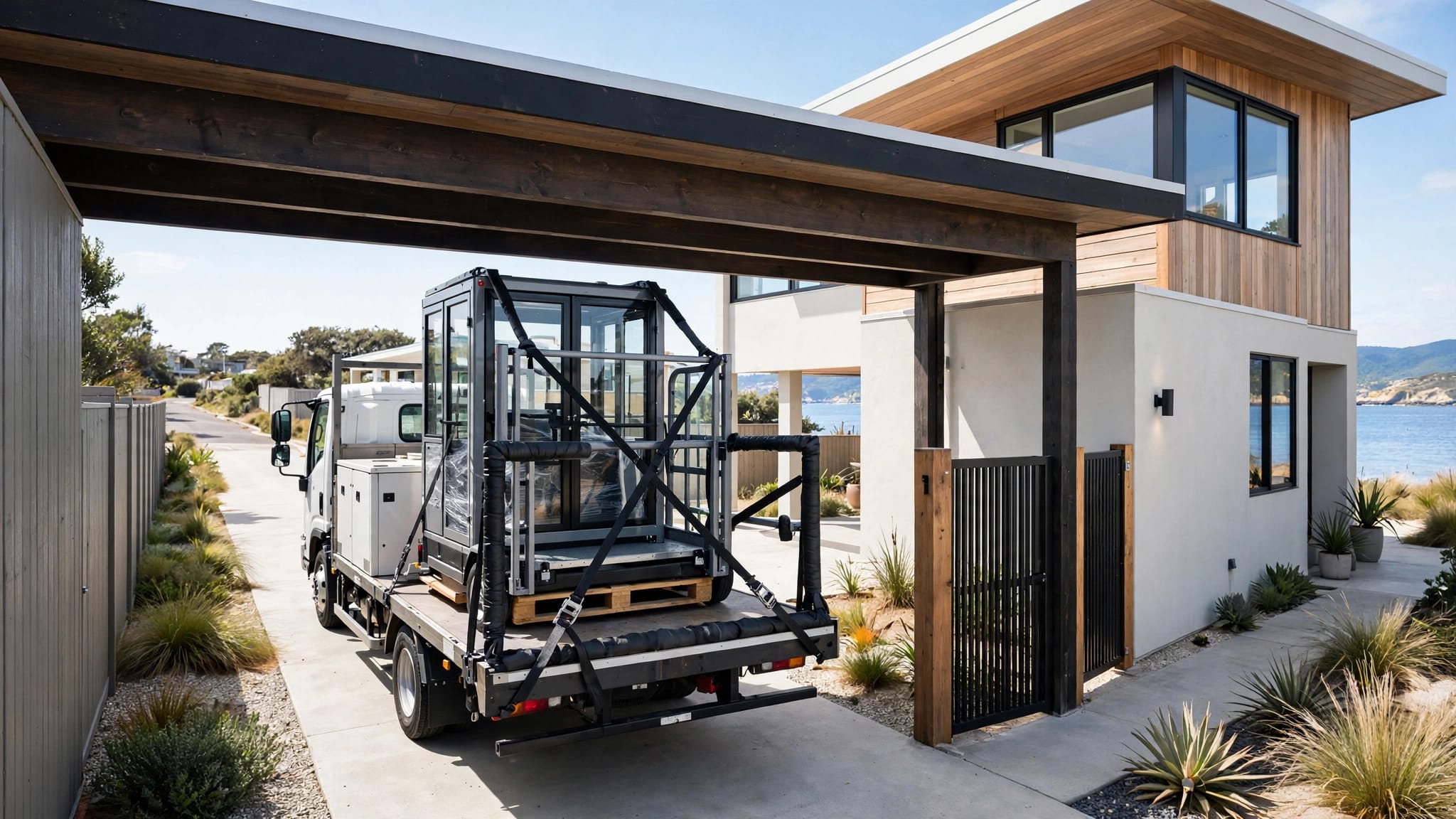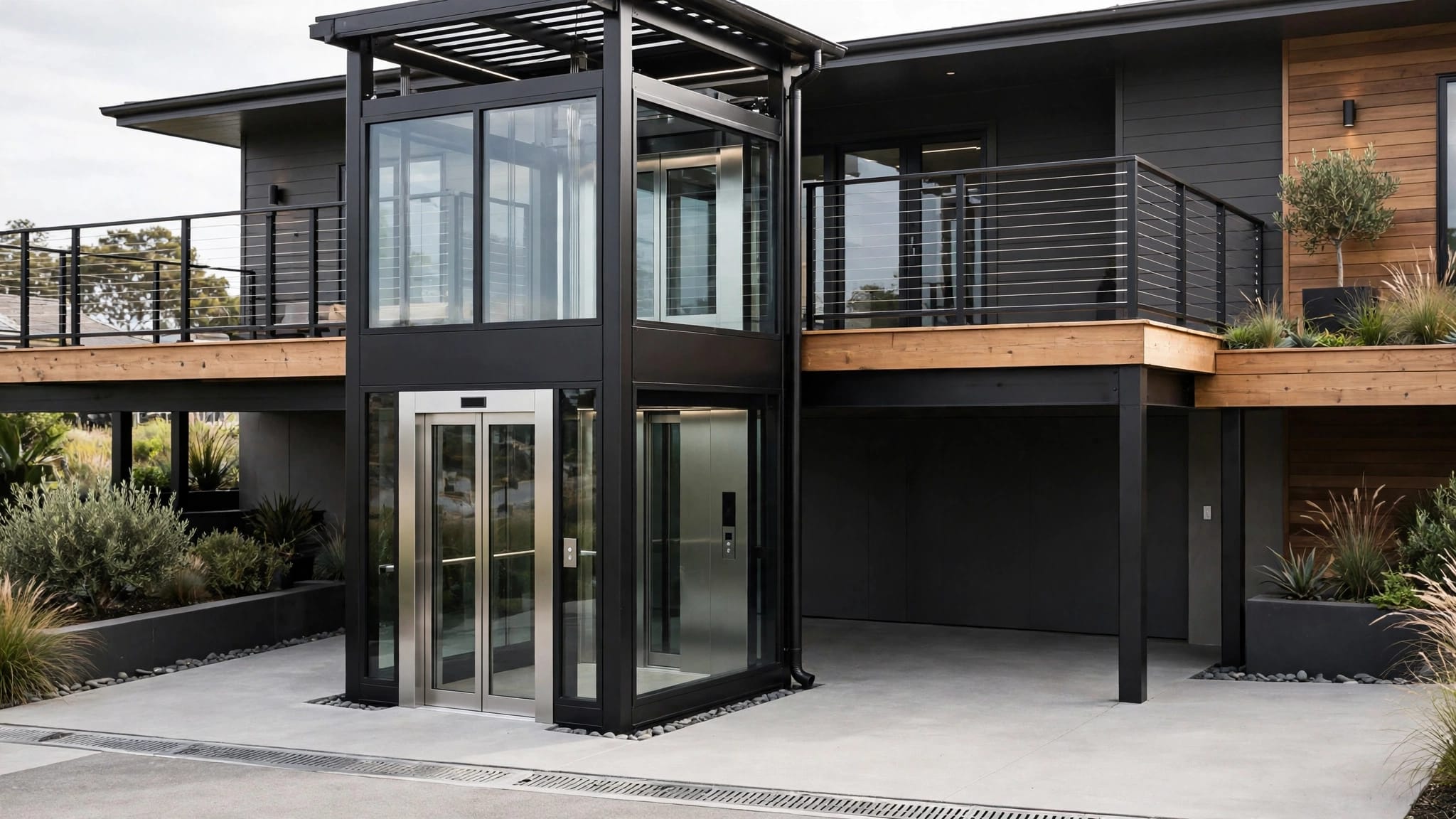
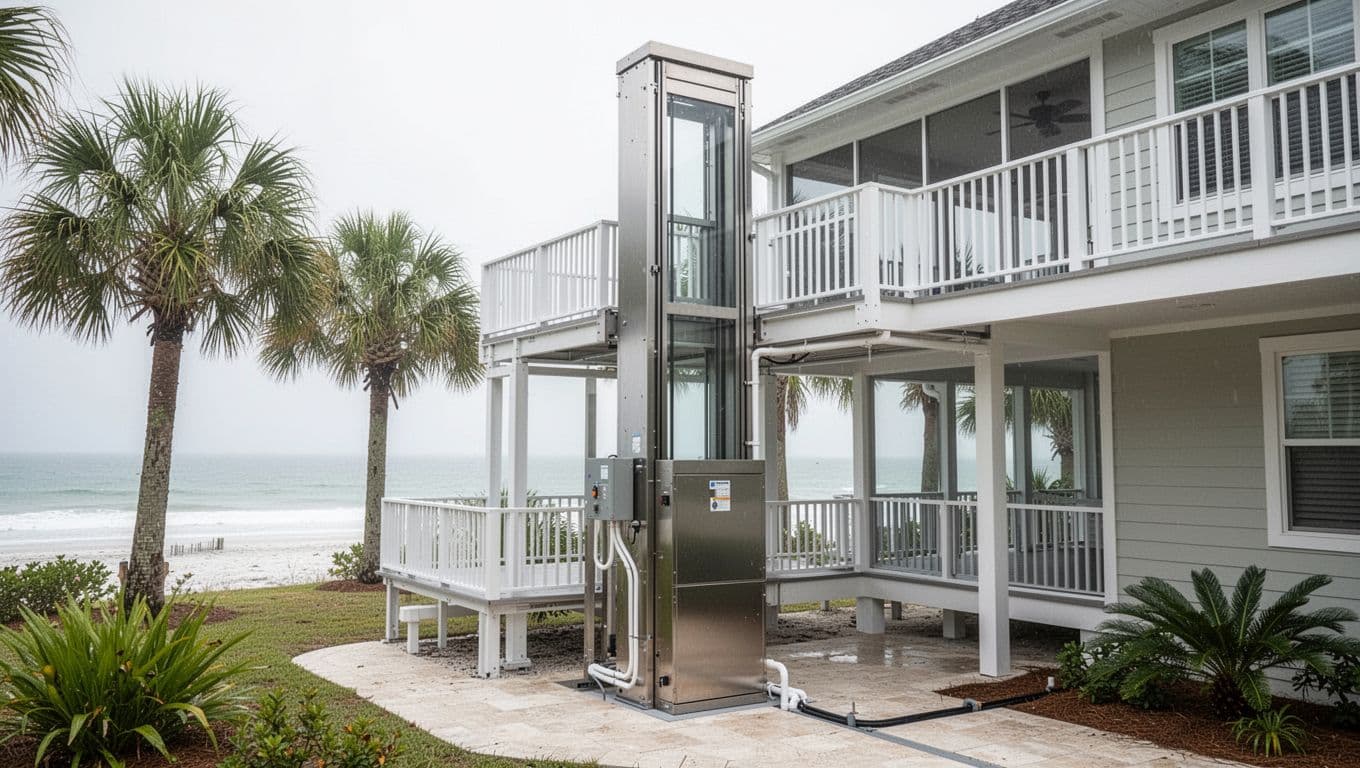

A coastal lift can face more electrical stress in one storm season than an indoor unit sees in years. Outdoor elevator electrical requirements must account for salt spray, wind-driven rain, standing water, humidity, flood exposure, and the exact lift installed.
A dependable installation starts long before the equipment arrives. Your elevator contractor, licensed electrician, builder, utility provider, and local authority having jurisdiction (AHJ) need the same plan.
Why coastal conditions change the electrical plan
An exterior elevator sits in a harsher environment than a garage-mounted or interior unit. Salt carried in humid air settles on metal parts and electrical connections. Rain can enter through gaps that look harmless on a dry day. Floodwater can damage equipment that remains powered after a storm.
Coastal installations also need a practical service layout. An electrician must be able to safely inspect, isolate, and test the equipment without standing in water or working around corroded hardware.
Salt air attacks more than visible metal
Salt deposits can corrode conduit fittings, cabinet hinges, grounding connections, fasteners, and terminals. The damage may start inside an enclosure, where it is hard to spot until a fault, nuisance shutdown, or intermittent control issue occurs.
Choose listed equipment and wiring methods suited to the site. The elevator manufacturer should confirm approved corrosion-protection options, enclosure types, and hardware for the installation address. A generic "outdoor rated" label doesn't automatically mean the product suits an exposed beachfront location.
Wind-driven rain finds weak details
Rain rarely falls straight during a coastal storm. It can push through door seams, conduit entries, poorly sealed fittings, and the top of an equipment cabinet.
The lift design should route water away from electrical components rather than relying on caulk alone. Careful conduit support, approved fittings, protected entry points, and a properly designed cover all matter.
Outdoor elevator electrical requirements start with the exact model
There is no universal voltage, amperage, conductor size, disconnect type, or breaker selection for an outdoor lift. Passenger elevators, cargo lifts, and vertical platform lifts can have different controllers, motors, safety circuits, and installation instructions.
The electrician should use the manufacturer's current electrical data, wiring diagrams, field requirements, and approved accessory list. Then the electrician can calculate the service and circuit needs under the electrical code adopted by the local jurisdiction.
Intended use affects the electrical design
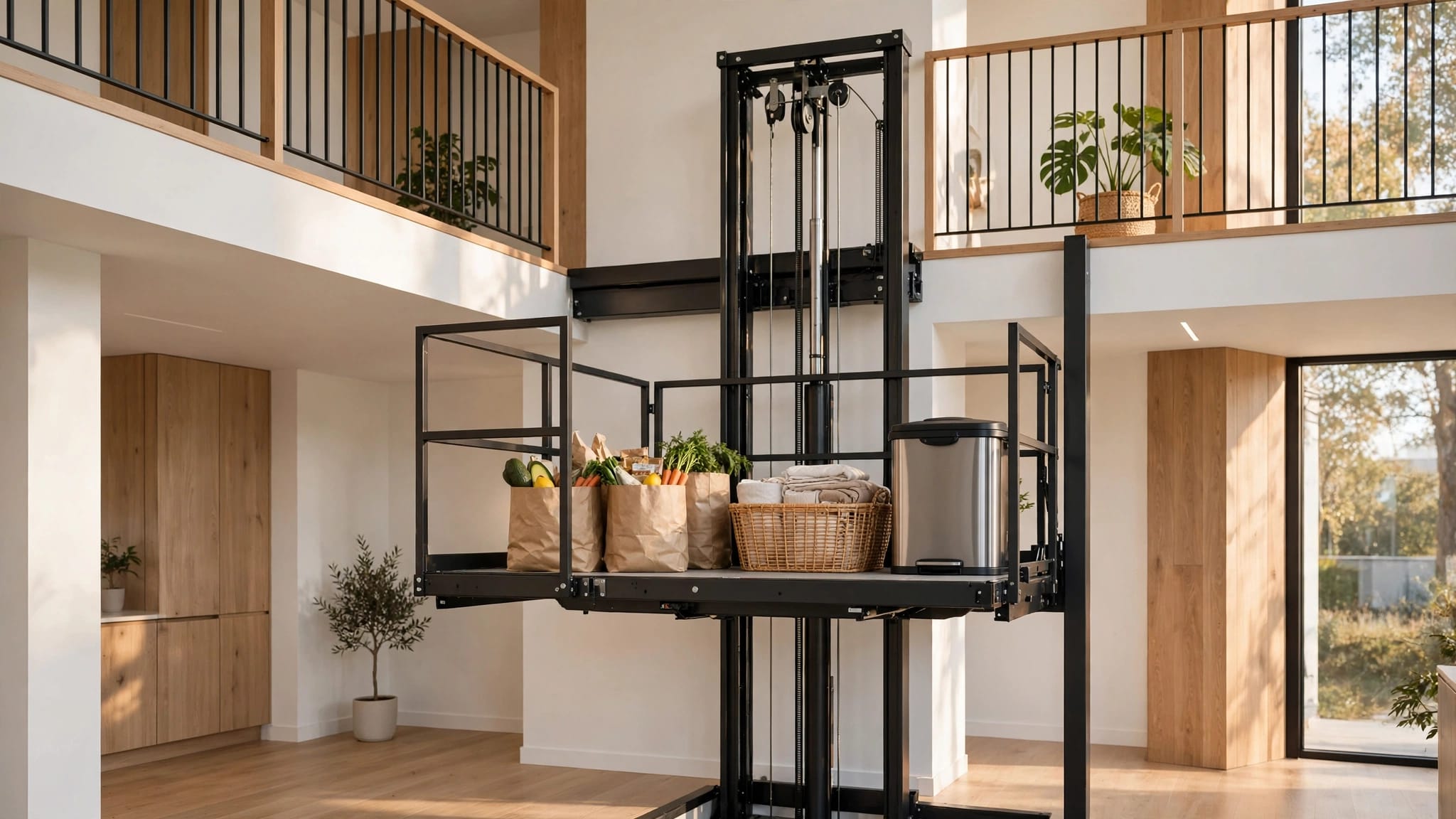
A cargo lift that moves groceries, furniture, tools, or supplies is not automatically approved for people. Passenger-compliant elevators have different safety, control, door, and inspection expectations. A vertical platform lift may be appropriate for a shorter accessibility rise, yet it follows its own product and approval path.
Clarify the job before service design begins. This comparison of a cargo lift versus passenger elevator helps owners match the equipment to its intended use.
Plan for the whole electrical load
The lift motor is only part of the electrical picture. Depending on the model, the system can include lighting, door operators, call stations, safety circuits, alarms, intercoms, battery charging, monitoring equipment, and a controller.
The electrical plan should show the service source, protective devices, disconnect location, conduit route, grounding path, and surge protection strategy where required or recommended. It should also identify who supplies each component.
Put the AHJ and utility provider on the schedule early
A local AHJ decides which electrical, building, floodplain, elevator, and accessibility rules apply. Requirements may differ between neighboring towns, counties, and coastal districts. The code edition in force when you apply for a permit also matters.
The builder should not wait until installation week to ask about service capacity or meter changes. Utility work, panel upgrades, and permit reviews often take longer than setting the lift itself.
Separate drawings prevent field conflicts
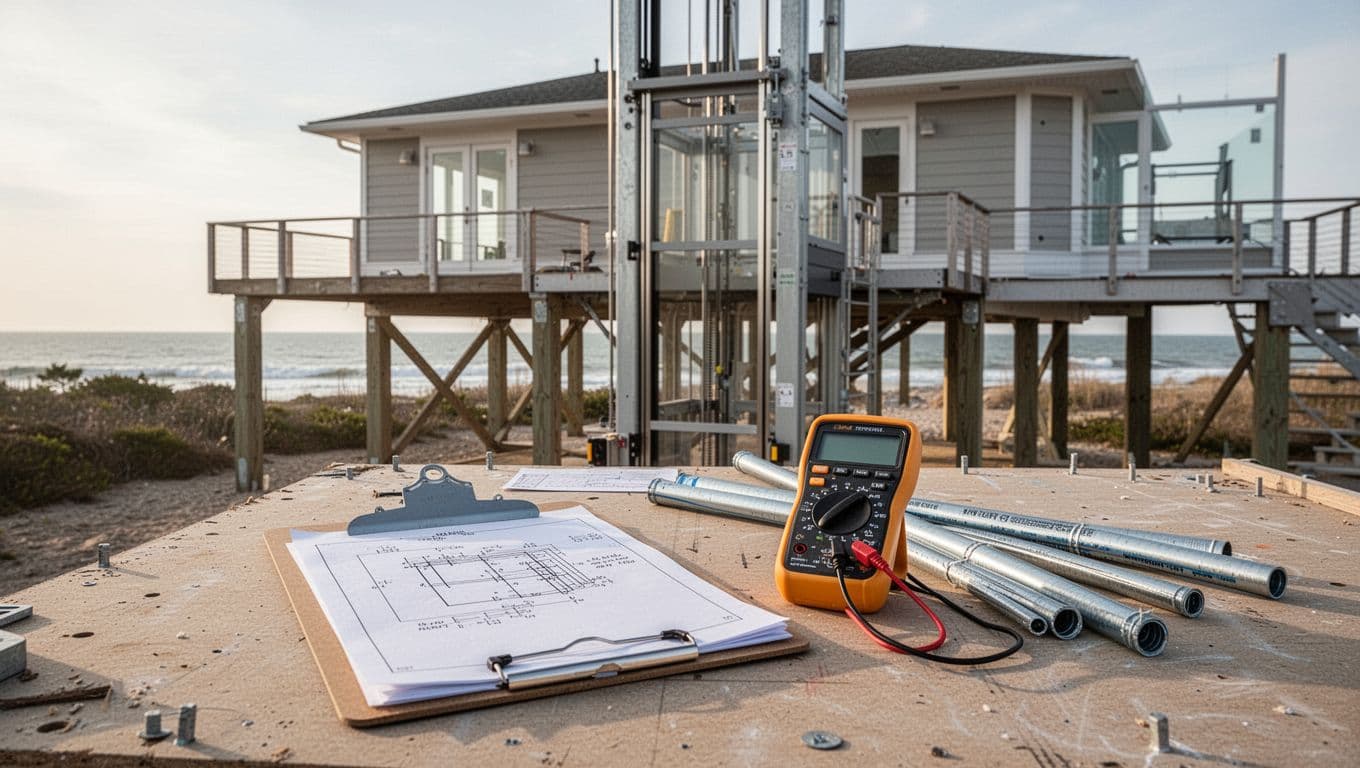
The elevator contractor should provide model-specific information early enough for the electrician and designer to use it. That package may include electrical characteristics, controller dimensions, disconnect guidance, equipment clearances, wiring diagrams, and environmental limits.
Meanwhile, the building plans should identify the lift location, landings, structural supports, drainage route, flood zone, and access path. Review Florida outdoor elevator code requirements before final drawings go to permit.
Permits and inspections often involve several reviewers
A project may require building, electrical, floodplain, and elevator-related reviews. The exact process depends on the equipment and jurisdiction. Some locations also have separate inspection steps before the lift can operate.
The licensed electrician and qualified elevator contractor should perform the installation, testing, and permit work within their scopes. Owners should keep approved plans, inspection records, manufacturer documents, and maintenance information in a safe location.
Flood-zone planning protects the equipment that matters most
Flood maps and elevation data should shape the electrical layout before concrete, framing, or conduit work begins. Ask the design team to confirm the base flood elevation (BFE), design flood elevation (DFE), flood zone, and local freeboard requirements.
For coastal high-hazard areas, Zone V, Coastal A Zones, and flood-prone Zone A sites, the risks are not the same. Wave action, moving debris, and saltwater exposure can change both structural and electrical decisions.
Elevate controls and machinery where possible
FEMA Technical Bulletin 4 advises placing elevator components above required building elevations unless rules allow another approach. FEMA also identifies elevator lift machinery, circuit breaker boxes, and electrical junction boxes as equipment that should be protected from flood damage.
Placing controllers, disconnects, junction boxes, and related equipment above the DFE is often the strongest protection. However, the local AHJ and elevator manufacturer must approve the final arrangement. Access platforms, stairs, and service clearances also need review.
An elevator shaft's treatment under flood rules does not give its controller, disconnect, or wiring a free pass below the required elevation.
Floodwater needs a shutdown strategy
Flood-resistant materials can reduce damage, but they do not make submerged controls safe to operate. The system should include the manufacturer's approved flood-related protections and shutdown procedures.
FEMA guidance also calls for elevator controls that prevent a cab from descending into floodwater. The elevator contractor should explain how the selected model responds to a flood event, when power must be disconnected, and what inspection is needed before restart.
Use enclosures, conduit, and drainage as one system
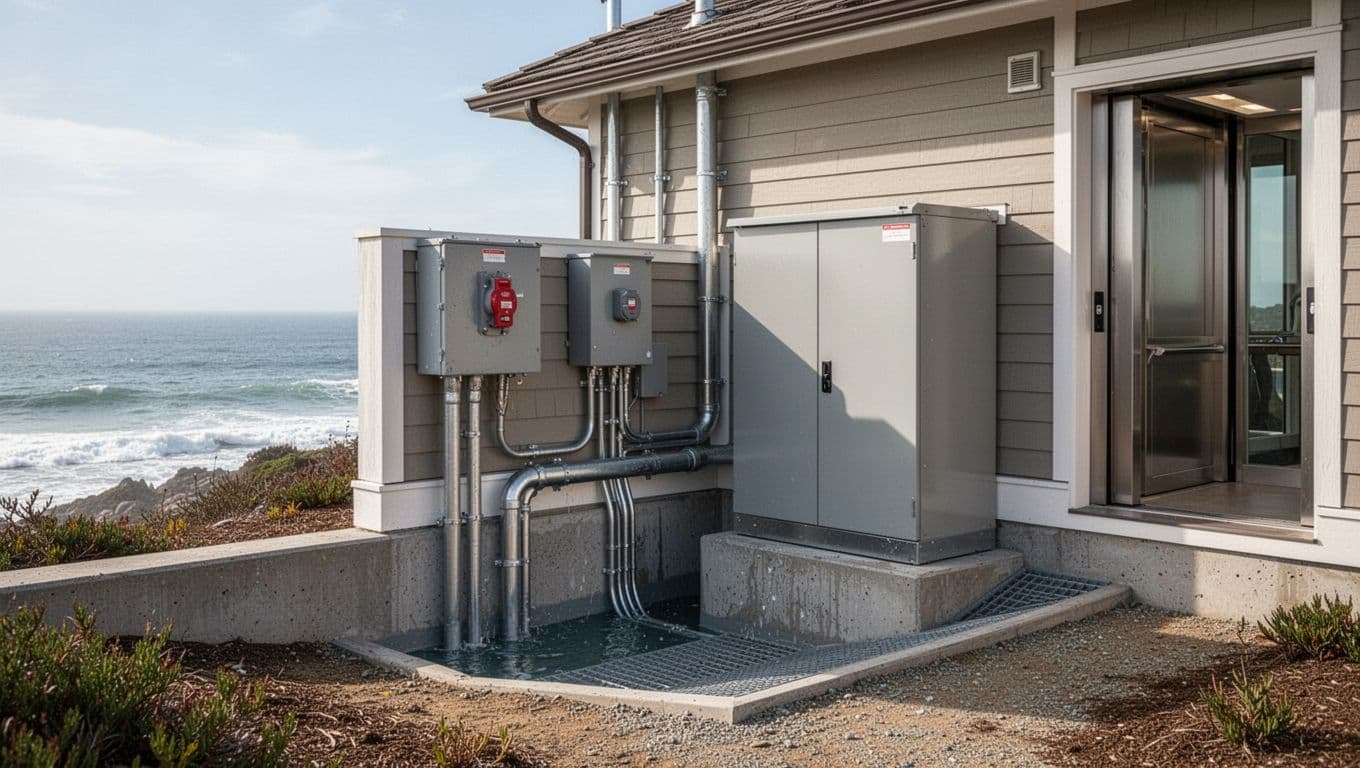
Water management is an electrical issue as much as a sitework issue. A watertight cabinet cannot solve a problem created by a downspout that discharges at the lift base or a slab that slopes toward the controller.
The design should carry roof runoff and surface water away from the hoistway, drive area, landing approaches, and electrical service equipment. It must also avoid creating a trip hazard at accessible landings.
Select enclosure protection for the real exposure
NEMA 3R, NEMA 4, and NEMA 4X describe different enclosure protection levels. The right choice depends on where equipment sits, how much direct weather it receives, its corrosion exposure, and the manufacturer's listing.
In a salt-air location, a corrosion-resistant enclosure and compatible fittings may be appropriate. Yet no enclosure type should be selected by habit. The lift manufacturer, electrician, and AHJ must confirm that the equipment remains listed for the planned environment.
Condensation needs attention inside protected spaces
Warm moist air can condense inside cabinets, conduit runs, and enclosed lift areas. This happens when a cool surface meets humid coastal air, even when rain never reaches the equipment.
Use only manufacturer-approved methods for condensation control. Do not drill improvised drain holes in listed cabinets or add heaters, vents, or sealants that conflict with the equipment instructions. The installer should also inspect low points in conduit runs where moisture might collect.
For broader sitework coordination, review exterior elevator drainage planning.
Disconnects, grounding, and circuit protection require coordination
The power source needs a clear, serviceable path to the lift. This includes correctly sized conductors, overcurrent protection, disconnecting means, raceways, grounding, bonding, and equipment working space.
Because the required arrangement depends on the model and locally adopted electrical code, avoid copying a wiring diagram from another project. A different controller location, motor type, or accessory package can change the design.
Keep the disconnect accessible and protected
The installer must place the disconnect where service personnel can reach it safely and where the location meets the manufacturer's instructions and local rules. It needs proper identification, appropriate weather protection, and required working clearance.
Avoid burying the disconnect behind landscaping, deck storage, gates, or furniture. It should also remain above likely ponding water and outside areas that flood during routine heavy rain.
Grounding and bonding control fault risk
A coastal lift has metal structures, cabinets, conduit, and electrical equipment that may require grounding and bonding under the adopted code and manufacturer instructions. Corroded or loose connections can defeat that protection.
The electrician should inspect bonding jumpers, grounding electrode connections, raceway continuity, and terminations during installation. Future maintenance should include a visual check for corrosion, damaged insulation, and loose fittings.
GFCI and AFCI protection may apply to certain circuits or locations, but neither should be assumed for every lift circuit. The electrician must confirm the current 2026 local code requirements, the circuit purpose, and the manufacturer's compatibility guidance before finalizing protection.
Plan for outages, lightning, and post-storm restart
Power loss can leave a passenger stranded or stop a cargo platform between landings. The emergency plan must match the equipment. Some systems use battery lowering, alarm communication, manual procedures, or an approved backup source.
Ask the elevator contractor what happens during an outage and what testing the system needs. Do not connect a generator or battery system without written manufacturer approval and a design from a qualified electrical professional.
Surge protection deserves a coastal review
Florida storms bring frequent lightning and utility disturbances. Controllers, variable-frequency drives, communication lines, and safety circuits can be vulnerable to transient voltage.
A coordinated surge protection plan may include devices at the service equipment and other approved locations. The design has to match the lift controls and the electrical system. Lightning protection for outdoor elevators also deserves discussion before final wiring begins.
Restart only after a proper inspection
After flooding, saltwater spray, lightning damage, or physical impact, keep the lift out of service until qualified personnel inspect it. A dry controller cabinet does not prove that hidden wiring, switches, safety devices, or grounding connections remain safe.
Document storm damage with photos before repairs. Then follow the elevator manufacturer's restart procedure and any local inspection requirements.
Pre-installation checklist for coastal elevator power
A complete site review reduces change orders and avoids unsafe last-minute fixes. Bring the elevator contractor and licensed electrician into the project before the foundation, framing, and service work are locked in.
- Confirm whether the unit is a passenger elevator, cargo lift, or vertical platform lift, and never plan for riders on equipment not rated for people.
- Obtain the current manufacturer electrical documents, environmental limitations, approved disconnect details, and controller location requirements.
- Verify service capacity with the electrician and utility provider before ordering equipment or scheduling installation.
- Identify the BFE, DFE, flood zone, local freeboard, wind exposure, and any coastal construction rules.
- Locate controllers, disconnects, junction boxes, and other sensitive equipment above required flood elevations when the approved design allows it.
- Map conduit routes, working clearances, grounding and bonding points, drainage paths, and access for future maintenance.
- Confirm enclosure ratings, corrosion-resistant materials, and compatible fittings for salt-air exposure.
- Submit coordinated drawings for permits, then schedule required electrical and elevator inspections.
- Record outage, flood, and storm-shutdown procedures where owners and service teams can find them.
Common mistakes that create costly coastal repairs
The first mistake is treating the lift as a late add-on. When electrical and drainage planning happens after framing or deck work, the crew may face awkward conduit routes, inaccessible disconnects, or equipment positioned too low.
Another frequent error is assuming one project establishes the rule for the next. Outdoor elevator electrical requirements shift with the model, jurisdiction, utility service, flood elevation, exposure level, and code edition.
Avoid these shortcuts:
- Don't select a breaker, conductor, or enclosure rating without the current manufacturer documentation and a licensed electrician's design.
- Don't place electrical equipment where roof runoff, irrigation, splash zones, or floodwater can reach it.
- Don't cover corrosion with paint and call the problem solved. Replace unsuitable hardware and correct the source of moisture.
- Don't defeat listed equipment features with field-made holes, unapproved seals, or improvised generator connections.
- Don't skip final testing because the lift moves. Safety circuits, alarms, controls, grounding, and emergency functions need verification.
A safer coastal installation starts on paper
Coastal lift projects work best when the electrical layout, flood strategy, drainage plan, and equipment selection agree before construction begins. The strongest design protects sensitive equipment from salt, water, and poor access while following the lift manufacturer's instructions.
Treat outdoor elevator electrical requirements as a project-specific design task, not a standard wiring detail. Qualified elevator and electrical professionals can turn the approved plans into a lift that is safer to operate and easier to maintain.
Recent Posts